.svg)


.svg)
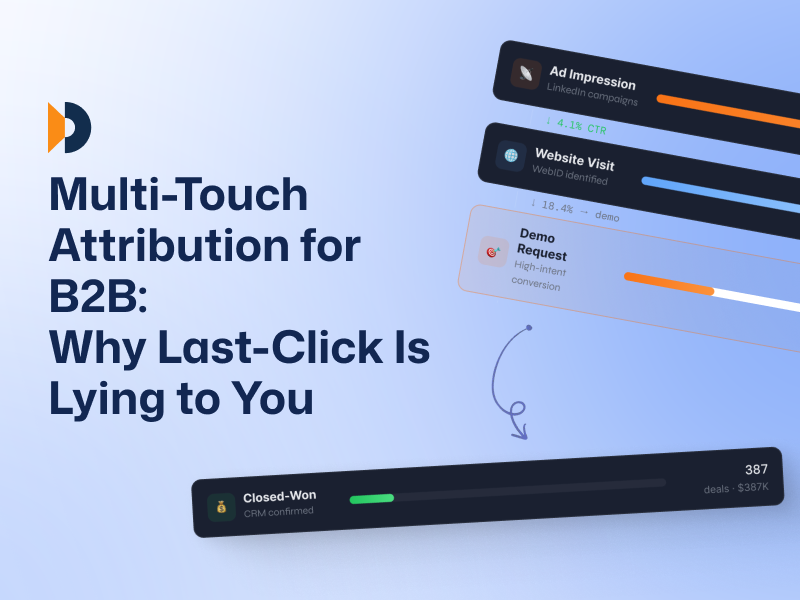
You ran a LinkedIn campaign for eight weeks. Strong impressions, solid engagement, right job titles clicking through. Then the pipeline report comes out — and the campaign gets zero credit. Every deal that closed attributed to a Google search or a direct visit.
So leadership calls it a failed experiment and moves the budget. What nobody saw was that those same prospects had engaged with your LinkedIn ads weeks earlier. They just didn't convert there.
In B2B, LinkedIn rarely gets the last click. But it's often responsible for the first real moment of awareness. Last-click attribution can't see that — and the budgets it influences reflect that blind spot every single quarter.
This article covers the main attribution models, why LinkedIn is uniquely hard to measure, and what a better setup actually looks like. If you're already running LinkedIn ads and want to see how campaigns connect to real CRM deals, revenue attribution tools can close that gap — but the model underneath still matters. That's what we're here to work through.
In this article, we look at an overview of attribution models, why LinkedIn is uniquely hard to attribute, and a better attribution setup that gives LinkedIn the credit it deserves.
What Last-Click Actually Measures (And What It Misses)
Last-click attribution waits by the finish line and hands the medal to whoever crosses it last. But B2B buying isn't a sprint — it's a relay race. Six people pass the baton, and last-click only sees the final handoff.
LinkedIn is where this flaw shows up most. Here's why.
The Window Problem
LinkedIn's default attribution window is 30 days. The average B2B sales cycle is 3 to 6 months. A VP sees your LinkedIn ad in January, goes dark, re-engages in March, and converts in April after a sales call. By the time that deal closes, LinkedIn's attribution window expired months ago. The assist goes unrecorded.
The Dark Social Problem
A lot of LinkedIn's real influence never shows up in a dashboard. Someone screenshots your ad and shares it in Slack. A director forwards your LinkedIn post to three colleagues. A procurement manager drops your case study in a WhatsApp group. Every one of those touchpoints shaped the deal. Every one is completely invisible to your attribution tool.
This is dark social, and on LinkedIn, it's rampant. The platform is built for sharing and conversation — which means a meaningful chunk of its influence happens off-platform and off the record. The fix isn't a better analytics tool; it's a self-reported attribution question on your form. A simple "how did you hear about us?" dropdown recovers more of this than most teams expect.
The Anonymous Visitor Problem
A director at a target account sees your LinkedIn ad, clicks through to your pricing page, and leaves without converting. Two weeks later she's back — direct traffic this time. Last-click credits the direct visit and forgets the LinkedIn ad that put her on your radar.
This isn't rare. Over 90% of website visitors don't convert on their first visit. They research, leave, and return when they're ready. Last-click picks up the return journey and ignores everything that led to it.
The Multiple Stakeholder Problem
In most B2B deals, you're convincing a room, not a person. The VP discovers you through LinkedIn. The IT lead researches you through organic search. The CFO sees a retargeting ad. One person eventually fills out the form — and last-click credits whoever influenced that one person last. The other four stakeholders building internal consensus around your product? The model has no space for them.
Multi-Touch Attribution Models: A Practical Overview
Here's a breakdown of each model and how they compare for B2B LinkedIn campaigns.
Last-Click: Gives 100% credit to the final touchpoint. Everyone else who contributed gets nothing.
First-Click: Gives 100% credit to the first touchpoint. Better for understanding what creates initial awareness, but ignores everything that closed the deal.
Linear: Distributes credit equally across all touchpoints. At least LinkedIn gets something — but it treats a first impression the same as a demo request.
U-Shaped: Assigns roughly 40% to the first touch, 40% to lead creation, and splits the remaining 20% across everything in between. Rewards top-of-funnel influence without ignoring what closed.
W-Shaped: Splits credit across three key moments — first touch, lead creation, and opportunity creation (each ~30%), with the remaining 10% spread across touchpoints in between. Good for teams tracking the full B2B funnel.
Data-Driven / Algorithmic: Uses machine learning to assign credit based on what actually correlates with conversions in your data. Strong when volume exists; unreliable without it.
Why LinkedIn Is Uniquely Hard to Attribute
LinkedIn's influence doesn't disappear when the buying gets serious. It just stops being visible. Here's why the gap exists.
30-Day Window vs. 3–6 Month Sales Cycle
LinkedIn Campaign Manager defaults to a 30-day attribution window. Most B2B sales cycles run 3 to 6 months. That mismatch means the majority of LinkedIn-influenced pipeline is invisible by the time deals close — not because LinkedIn didn't work, but because the window closed before the deal did.
The fix is straightforward: extend your window to 90 days minimum in both Campaign Manager and your CRM. Enterprise teams with longer cycles should push to 180.
Multi-Stakeholder Journeys
A realistic B2B buying journey looks something like this: the champion engages with thought leadership content and shares posts internally. The economic buyer clicks a sponsored case study six weeks later. The technical evaluator finds your docs through organic LinkedIn search. Each person touches different content at different times, often from different devices.
Attribution tools built for single-user journeys collapse under this. The champion's early LinkedIn engagement — the one that started the whole deal — may never connect to the closed-won record in your CRM.
Anonymous Site Visits
Over 90% of website visitors never convert on their first touch. Most LinkedIn ad clicks land on your site, browse for a few minutes, and leave without filling out a form. They evaluate your pricing page, read a case study, check your about page — then disappear into the CRM as anonymous sessions that get zero credit. Visitor identification tools surface the accounts behind those anonymous visits, so you know who's in-market even when they never raise their hand.
Dark Social
When a VP shares your LinkedIn post into their company's #revenue Slack channel and three colleagues visit your site directly the next morning, that influence is real. It shaped the purchase decision. But it registers in GA4 as direct traffic with zero LinkedIn credit.
Dark social is where B2B brands actually build — and it's completely invisible to standard attribution. The self-reported attribution field on your lead form is the only practical way to recover it.
What a Better Attribution Setup Actually Looks Like
Most of these fixes take an afternoon. The reason they don't happen isn't complexity — it's that no one owns them.
UTM Discipline
This is where attribution most commonly falls apart before it even starts. If one campaign manager writes "LinkedIn," another writes "linkedin," and a third writes "li-paid," your source data fractures into three separate channels in every downstream report. A shared naming convention document — locked, enforced at campaign setup — is the foundation everything else sits on.
Extend Attribution Windows
LinkedIn defaults to 30 days. Your sales cycle doesn't close in 30 days. Go into Campaign Manager and your CRM and change both to 90 days minimum. If you're an enterprise B2B team with longer cycles, push to 180. This single change will surface attribution that's been hiding in your data for months.
CRM Integration
LinkedIn and your CRM are two separate data silos by default — unless you actively connect them. When properly integrated, you can open a lead record and see "first touch: LinkedIn campaign X, ad Y, date Z" — not just the form fill source. That's the difference between knowing LinkedIn helped and being able to prove it.
Visitor Identification
UTM discipline and window extension both require someone to convert. Visitor identification addresses the structural gap for everyone who doesn't. Tools that surface account-level intent turn anonymous traffic into signals your sales team can actually act on — without waiting for a form fill.
Self-Reported Attribution
A simple dropdown asking "how did you hear about us?" It captures what no tracking pixel can: the LinkedIn post a colleague shared in Slack, the screenshot that circulated in a buying committee, the DM that sent someone to your site without leaving a trace. Add it to every lead form. Review it quarterly.
Who This Doesn't Apply To
The setup above is worth building when LinkedIn is one of several channels driving meaningful pipeline and you need to understand its relative contribution. That's not every team.
Small Budgets (Under $2K/Month on LinkedIn)
At sub-$2K monthly spend: a consistent UTM convention, an extended attribution window, and a "how did you hear about us?" field are enough. Come back to the rest when the spend justifies it.
If LinkedIn Is Your Only Active Channel
Multi-touch models distribute credit across channels that contribute to the same conversion. If there's only one channel in play, the model is redundant.
If You're Still Working Out Your ICP
Attribution model precision is premature optimization if you're still figuring out who converts. Focus on talking to customers and finding what works. The measurement layer comes after the motion is working.
Wrapping Up...
The problem was never that LinkedIn doesn't work. The problem is that last-click attribution was designed for a world where a single person buys something immediately after clicking an ad. B2B buying doesn't work that way — and measuring it as if it does quietly kills the channels responsible for the early influence that starts deals.
Better models exist. Start by extending your attribution window and auditing what's actually reaching your CRM. That alone will change what the numbers say about LinkedIn — and probably change what you decide to do with the budget.

![How to Use LinkedIn Sales Navigator Search Filters Like a Pro [2026 Guide]](https://cdn.prod.website-files.com/67160f781eeef22eaf34d58e/69ce69e4309170b938673cf6_LinkedIn%20Sales%20Navigator%20-%20Thumbnail.png)