.svg)


.svg)
Industry: B2B SaaS / Workplace Technology
Campaign Type: Top-of-Funnel Awareness
Test Duration: 2 weeks
At a Glance
The Challenge
Workplace management software lives in a narrow marketing position. The buying decision typically involves facilities managers, HR leaders, and senior operations executives — a specific audience that's harder to reach efficiently on LinkedIn than broader professional categories.
This platform, which helps global organizations optimize office spaces using behavioral data and employee insights, was running awareness campaigns to build visibility with those decision-makers. The campaigns were technically working, but efficiency was the problem. Budget was spreading thin across hours and days when their specific audience simply wasn't engaged.
Workplace and facilities professionals aren't checking LinkedIn at midnight or on Sunday afternoons. They work structured schedules, and their engagement with professional content follows those schedules closely. The campaign was paying for a lot of impressions that happened outside the window where they actually mattered.
The question: does concentrating delivery during peak professional hours change the economics — and if so, by how much?
The Approach
Rather than running a single test, the team ran two campaigns simultaneously — each split into an always-on control and a scheduled test variant. Both used DemandSense's scheduling capabilities with identical creative and audience targeting.
Test structure:
- Two separate top-of-funnel campaigns running in parallel
- Each campaign split: always-on delivery (control) vs. DemandSense scheduling (test)
- Same budget, same creative, same audience across both variants
- 2-week test period
Scheduling parameters:
- Weekdays only: Monday through Thursday
- Business hours: 8am to 6pm, with peak concentration during 9am to 3pm
- Weekends excluded entirely
- Time zone aligned to the target audience's working hours
Running two campaigns simultaneously rather than one gave a stronger signal — if both scheduled variants outperformed their controls, the timing effect was real. If only one improved, it could be creative variance.
The Results
Impressions Up Across Both Campaigns
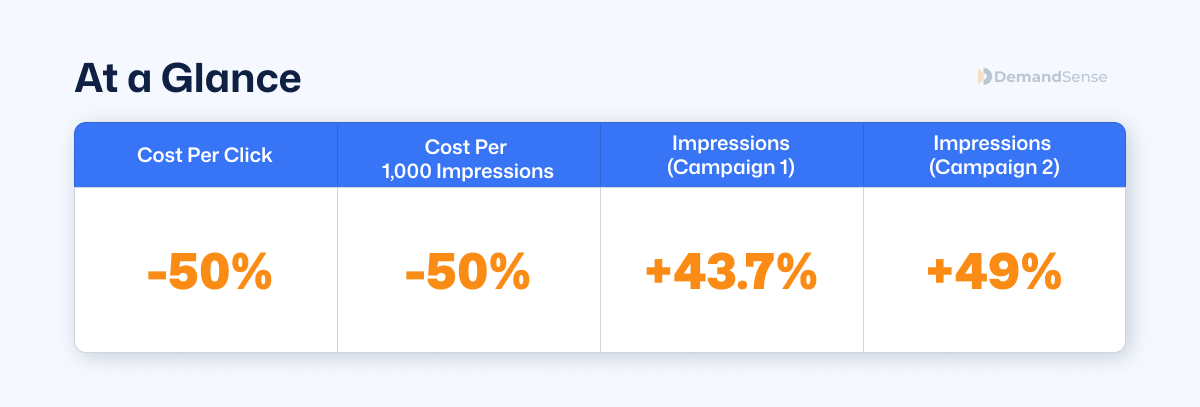
Campaign one: impressions increased 43.7%. Campaign two: impressions increased 49%. Both scheduled variants beat their always-on controls by a significant margin, and the consistency across two separate campaigns confirmed this wasn't noise — it was the timing.
The mechanism is counterintuitive but logical: when you stop wasting budget on off-hours impressions, the same spend reaches more people during the windows that matter. Budget concentration during peak hours means winning more relevant auctions, not fewer.
Costs Dropped Significantly
Both campaigns saw substantial reductions in CPM and CPC. By concentrating delivery during business hours, the campaigns competed more effectively in the auctions that mattered — and paid less for each impression and click as a result.
For a platform targeting a narrow, specific audience, cost efficiency isn't a nice-to-have. It's the difference between a campaign that's sustainable at current budgets and one that requires constant spend increases just to maintain reach.
The Consistency Is the Signal
One campaign outperforming its control could be a fluke. Two campaigns improving in similar ranges is evidence. The timing change alone — applied consistently across different creatives in the same test period — produced consistent results. That's the signal worth acting on.
Why It Worked
Workplace and facilities professionals are among the more schedule-driven B2B audiences on LinkedIn. They work in physical environments with clear start and end times, and their engagement with professional content follows suit. Ads that show up during working hours reach people in a professional mindset — which is exactly the context that makes B2B content land.
Weekday concentration also reduced auction competition. Many advertisers still run 24/7, which means focused delivery during business hours found a more favorable competitive position than trying to compete across all hours simultaneously.
Key Takeaways
Two campaigns beat one for validation. Simultaneous tests across different campaigns give stronger evidence than a single result. If scheduling improves both, it's worth rolling out to the full account.
Narrow audiences benefit most from scheduling. When you're targeting a specific professional persona — workplace managers, facilities directors, HR ops leaders — timing precision matters more than for broad consumer categories. These audiences have predictable engagement patterns worth exploiting.
Budget concentration compounds. The 43–49% impression lift didn't come from spending more. It came from spending the same budget where it actually worked.
Want to Test This Yourself?
These results came from a controlled test using DemandSense's ad scheduling capabilities. If you're running LinkedIn campaigns and wondering whether strategic timing could improve your performance, the only way to know is to test it.
Watch a quick demo to see how DemandSense's LinkedIn ad controls work, or learn more about our scheduling features.

![How to Use LinkedIn Sales Navigator Search Filters Like a Pro [2026 Guide]](https://cdn.prod.website-files.com/67160f781eeef22eaf34d58e/69ce69e4309170b938673cf6_LinkedIn%20Sales%20Navigator%20-%20Thumbnail.png)