.svg)


.svg)
Right now, someone from your ideal customer profile is researching your product.
They're comparing your pricing to competitors. Reading your case studies. Watching your product demos. Maybe they've visited your site three times this week.
And you have absolutely no idea who they are.
This is the reality for 96% of your website traffic. People browse, research, and leave without filling out a single form. No name. No email. No way to follow up.
For B2B companies running LinkedIn ads, this problem is even more painful. 75% of B2B teams pay over $6 per click. Those clicks add up to thousands of visitors per month. But only 3-4% ever identify themselves.
The others just vanish.
What if you could see who they are? Not just which companies visited, but actual names, titles, and contact information for the people researching your solution right now.
That's what website visitor identification does. And when done right, it transforms how you run marketing and sales.
Why Most Visitor Identification Falls Short
Website visitor identification isn't new. Tools have existed for years that tell you "someone from Acme Corp visited your pricing page."
Cool. But which someone? Was it the CEO? An intern doing research for a school project? The IT person checking your security docs? A competitor scoping your positioning?
Company-level identification creates more questions than answers.
You can't personalize follow-up. You don't know who to target with ads. Your sales team can't prioritize effectively. And you definitely can't prove which marketing efforts actually drive revenue.
The Remote Work Reality
Here's what's changed: Traditional visitor identification works great when someone visits from a corporate office. Their IP address maps directly to their company.
But B2B buying behavior has shifted. Today, nearly half of website traffic comes from home offices, coffee shops, and personal devices. Those visitors show up as residential IPs invisible to tools that rely solely on IP address matching.
This means the old playbook leaves a huge opportunity on the table. The prospects researching your product from their kitchen table or a coffee shop between meetings? They're just as qualified as office visitors, but standard identification methods miss them entirely.
The solution isn't better IP matching. It's identification technology that works regardless of where someone's working from.
What You Actually Need
Good visitor identification gives you:
- Individual-level data, not just companies. Names, job titles, seniority, departments. The actual person researching your product.
- Behavioral context. Which pages they visited, how long they spent, what content they consumed, how many times they've returned.
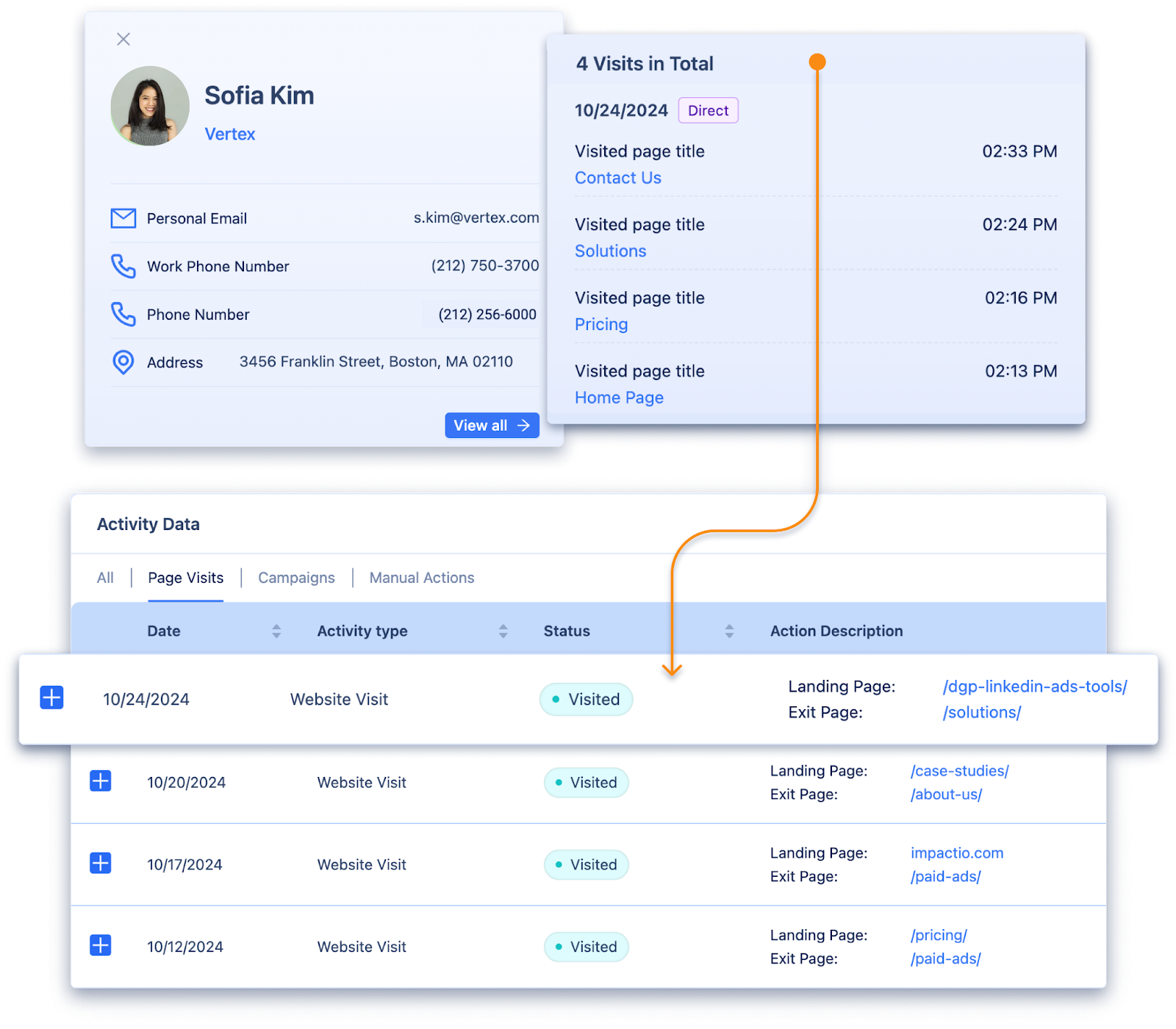
- Remote worker identification. Technology that works regardless of whether someone's in an office or working from their kitchen table.
- LinkedIn integration. The ability to build matched audiences and retarget the exact people who showed interest.
- Privacy compliance. Methods that respect GDPR, CCPA, and other regulations while still delivering actionable data.
How to Use Visitor Identification Data
Knowing who's on your site is step one. Actually using that information is where ROI happens.
Marketing Teams Can…
Build precision retargeting audiences
Instead of retargeting everyone who clicked your ad, you can create LinkedIn matched audiences based on what people actually did on your site.
Someone visited your pricing page? Add them to a demo offer campaign. Someone read three blog posts? Target them with educational content. Multiple people from the same company showing interest? Launch account-based messaging.
According to our benchmark data, this approach drives 2.5x higher conversion rates than cold prospecting.
Prove campaign ROI
You can finally see which LinkedIn ads drive which specific visitors, then track their journey from first click to closed deal, even when it takes 6+ months.
Most platforms only capture 20-30% of LinkedIn's actual impact because attribution windows are too short. Visitor identification connects the dots across your entire sales cycle.
Suppress low-fit traffic
When you can identify job seekers, students, competitors, and companies outside your ICP, you can exclude them from retargeting campaigns. No more wasting ad spend on people who'll never buy.
Sales Teams Can…
Prioritize outreach with context
Instead of "someone from Acme Corp visited," you see the full picture: whether it's a specific person researching your solution or a company-level pattern showing multiple stakeholders engaged across departments.
When DemandSense's scoring tool shows 5 visitors from the same company hitting pricing and integration docs over multiple sessions, you know the buying committee is brewing there.
That's a warm lead worth immediate follow-up, not a cold call.
Catch buying signals early
You can see when cold prospects start researching, notice when deals you thought were dead suddenly revisit your site, and identify when multiple people from the same company are all doing research simultaneously—a clear buying committee signal.
Accelerate pipeline velocity
When you engage prospects while they're actively researching (not months after they've moved on), your team has specific talking points based on what prospects actually looked at.
Is Visitor Identification Privacy-Compliant?
Here's the question everyone asks: "Is this creepy? Is it legal?"
Short answer: Yes, it's legal when done right. No, it's not creepy if you use it appropriately.
How It Actually Works
Website visitor identification doesn't hack into people's computers or spy on their personal lives. It uses publicly available business information and professional data sources.
Here's what it does:
- Matches visitor activity to business contact databases. When someone visits your site, the technology cross-references signals (IP address, cookies, behavioral patterns, device IDs) against databases of professional contact information from partners who have obtained proper consent and opt-in from business users.
- Uses B2B data sources. Business email addresses, LinkedIn profiles, company directories, professional social networks. This is all the information people have made public in a business context.
- Respects privacy regulations. We take a differentiated approach based on regional privacy laws. In the US, we identify both individual visitors and their companies. Outside the US, we provide company-level identification only to ensure full compliance with GDPR, UK GDPR, and other regional data protection requirements. This means you always get actionable intelligence while staying compliant with local regulations.
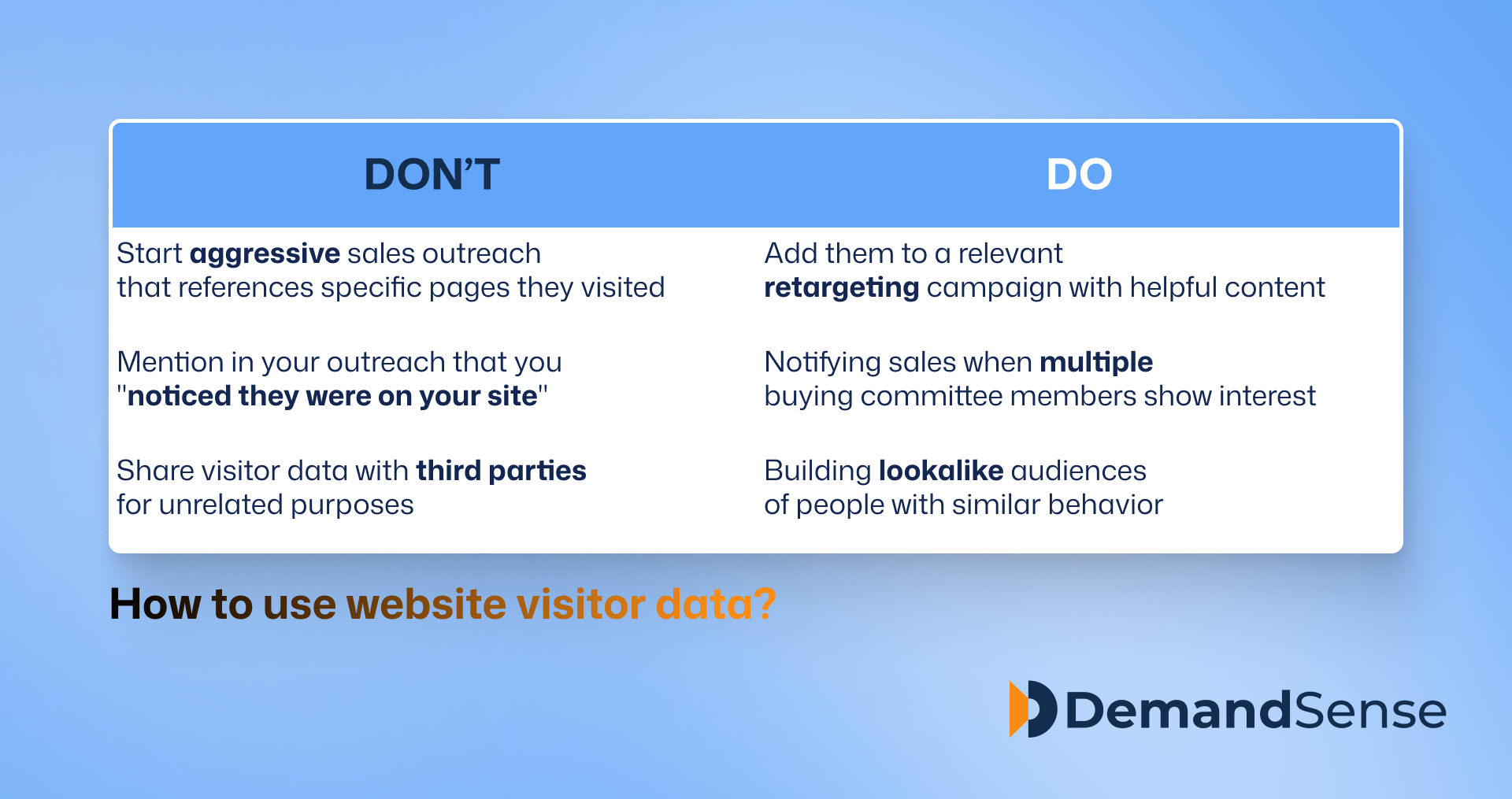
You Control How You Use This Data
Here's the reality: visitor identification gives you powerful information. What you do with it is up to you.
The technology shows you who's researching your product. How you engage with that information determines whether it feels helpful or invasive.
Think of it this way: someone walking into your physical store isn't giving you permission to follow them home. But they are signaling interest. The same applies online.
If your outreach would feel natural without the visitor data, you're probably fine. If it only makes sense because you've been tracking someone's clicks, you've crossed into surveillance territory.
The best companies use visitor identification to be more relevant, not more aggressive. They show the right content at the right time. They reach out when there's genuine mutual interest. They respect that research doesn't equal consent.
You have the tools. How you use them says everything about your brand.
When Visitor Identification Pays Off
Website visitor identification drives real impact in specific situations. Here's where it makes the biggest difference:
When attribution is broken
You're running LinkedIn ads but can't prove ROI because most conversions happen outside the standard 30-day window. Visitor identification tracks the complete journey from first click to closed deal, even when it takes months.
When retargeting budget is wasted
You're spending thousands retargeting everyone who clicked your ad—including students, job seekers, and competitors. Once you can identify who's actually visiting, you exclude low-fit traffic and focus on genuine prospects.
When sales is flying blind
Your team gets vague alerts like "someone from Acme Corp visited" but can't prioritize effectively. Individual-level identification shows exactly who's researching (Sarah Johnson, VP Marketing) and what they're interested in (pricing page, 3 visits this week).
When buying committees go unnoticed
Multiple people from the same company are researching your product, but you only reach out to one contact. Visitor identification reveals the full buying committee so your team can coordinate multi-threaded outreach.
When high-intent prospects slip through
People spend 10+ minutes on your pricing page or watch your demo video multiple times, then leave without converting. You never follow up because you don't know who they are. Visitor identification captures these high-intent signals before prospects disappear.
When content ROI is unclear
Your team publishes blog content but can't connect it to the pipeline. Visitor identification shows which articles drive qualified prospects to high-intent pages, proving which content actually matters.
Turn Anonymity into Action
Website visitor identification transforms how B2B companies run marketing and sales. You stop flying blind and start seeing who's actually interested in your solution.
The companies seeing the biggest impact aren't the ones with the most traffic. They're the ones who can see what's happening in their funnel and act on it strategically.
Start by understanding what percentage of your traffic you can currently identify. If you're like most B2B companies, it's probably under 30%. Every improvement in that number directly expands your pipeline.
Then think about what you'd do differently if you could see:
- Which LinkedIn ads drive which specific visitors
- Which prospects are actively researching right now
- Which accounts have multiple people showing interest
- Which high-intent visitors are slipping through unnoticed
That's the opportunity. And for B2B companies running expensive LinkedIn ad campaigns, it's the difference between proving ROI and constantly defending your budget.

![How to Use LinkedIn Sales Navigator Search Filters Like a Pro [2026 Guide]](https://cdn.prod.website-files.com/67160f781eeef22eaf34d58e/69ce69e4309170b938673cf6_LinkedIn%20Sales%20Navigator%20-%20Thumbnail.png)