.svg)


.svg)
Most B2B marketers think about audience targeting, ad creative, and budget caps. What they don't think about? The fact that LinkedIn doesn't care what time zone their buyers live in.
Every campaign budget on the platform resets at exactly 00:00 UTC. Not your local time. Not your audience's time zone. Your ads are tuned to a global clock that probably doesn't match where your ICP is based.
Here’s what it means for your campaigns: when your budget resets and starts spending has almost nothing to do with when your buyers are actually online and scrolling.
What can the disconnect look like?
- In Sydney, budgets reset at 10am. Your buyers are already in meetings, not checking their feed.
- In Tokyo, the reset happens at 9am. You've already missed the morning commute crowd.
- In San Francisco? It's 5pm the day before: people are shutting down for the day, not firing up LinkedIn.
This timing mismatch is why LinkedIn's time zone quirks actually matter. Without planning around it, your budget gets eaten up during low-activity hours. And since LinkedIn will spend your money as quickly as possible, those dollars aren't always reaching the right people at the right time.
When Scheduling Drives Results
Ad scheduling isn't a silver bullet, but it's one of the highest-leverage optimizations you can make for direct response campaigns.
It matters most when you're running conversion-focused campaigns with limited budgets. If you're working with $5K-$50K monthly spend and need every dollar to count, timing can be the difference between hitting your CPA targets and blowing through budget on low-intent impressions.
Of course, not all campaigns are equally dependent on timing. Brand awareness campaigns where you're optimizing for reach, retargeting audiences under 10K (they're online sporadically anyway), or ABM plays where you're hitting a small list of named accounts (volume isn't the constraint) are less hurt by the automatic reset.
Yet, even in these cases, controlling delivery timing rarely hurts performance. It just matters less.
The real opportunity is in matching delivery windows to engagement patterns. B2B audiences spike during commutes (7-9am), lunch breaks (12-1pm), and late afternoon wind-downs (3-5pm). Concentrating spend during these windows typically improves performance across the board—but only if your creative and targeting are already dialed in.
How You Can Fix the Time Zone Issue
LinkedIn doesn't offer native scheduling. So if you want your ads running when your audience is actually active, you're either manually toggling campaigns on and off or watching budget vanish during dead hours.
And here’s how you can change it with tools like DemandSense: With built-in ad scheduling, you can set time blocks by hour, day, or region, matching your delivery to actual business hours instead of letting LinkedIn blow through your spend whenever it wants.
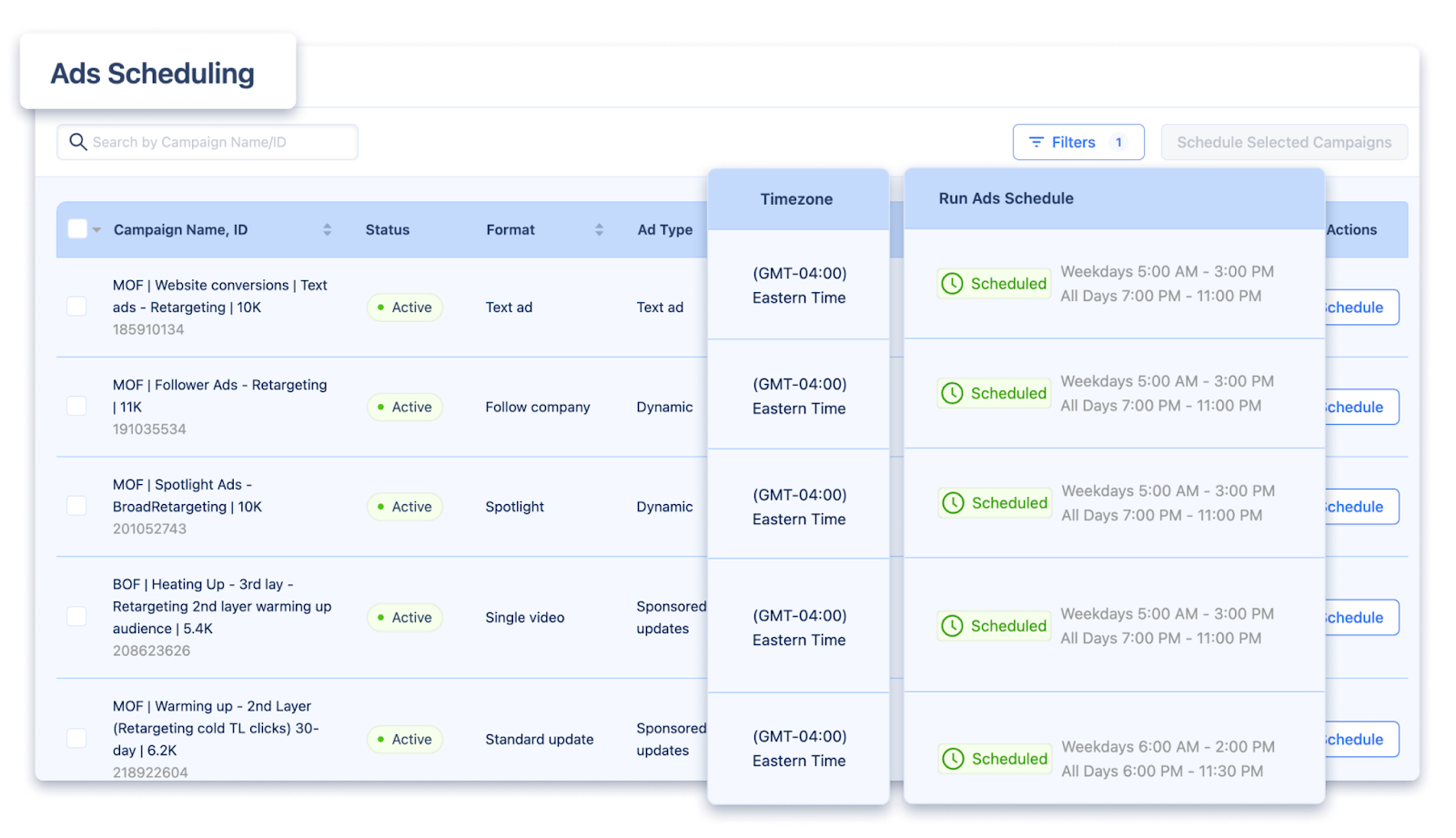
Since it's time zone aware, you can hit peak hours in each market without managing multiple schedules manually.
Once you set your parameters, the automation handles the rest. You also get budget controls at the account level, so you can group campaigns together and prevent overspend before it happens.
What Happens When You Schedule During Peak Hours
We wanted to see how much scheduling actually impacts the performance, so we ran a two-week A/B test. One campaign used LinkedIn's standard always-on delivery. The other used DemandSense scheduling.
Same audience. Same creative. Different timing strategy.
The scheduled campaign focused on weekday business hours: concentrating budget between 9am and 3pm and cutting weekends entirely. We also aligned delivery to each region's local time zone.
Here's what happened:
- Impressions: +66.9%
- Click-through rate: +19.8%
- Cost per thousand impressions: –47.6%
- Cost per click: –56.1%
These aren't small improvements. Cutting CPC in half while expanding reach shows just how powerful scheduling can be for reducing LinkedIn costs and boosting overall performance.
Common Scheduling Mistakes Anyone Can Make
- Running the same schedule across all geos. If you're targeting both US and APAC audiences, a single 9-5 schedule doesn't work. You end up optimizing for one region and completely missing the other. Either set region-specific schedules or split campaigns by geography so you can allocate budget appropriately.
- Only cutting weekends but leaving nights on. Weekends underperform, but so does 11pm on a Tuesday. If you're only pausing Saturday and Sunday, you're still burning 30-40% of your budget during low-engagement hours every weeknight.
- Not adjusting schedules by funnel stage. Top-of-funnel awareness content can run wider hours, as you're casting a net. But bottom-funnel conversion campaigns should be tightly scheduled around peak engagement windows. Treat them differently.
- Setting schedules based on your timezone instead of theirs. This sounds obvious but it happens constantly. Just because you're working 9-5 Eastern doesn't mean your buyers in California are active at 6am Pacific. Always schedule based on where your audience actually lives.
3 Tips for Scheduling Your LinkedIn Ads
- Start by auditing your current timing. Pull delivery reports from Campaign Manager and look at when impressions and clicks are actually happening. If most of your spend is hitting outside business hours, concentrate it between 9am and 3pm in your buyer's local time zone because that's when LinkedIn engagement peaks for most B2B audiences.
- Make sure you're aligning with time zones. If you're targeting multiple regions, set schedules that make sense for each one. Don't try to force a single global schedule and hope it works.
- Once your schedules are live, test and track. Watch your CTR, CPC, and CPM closely. Small timing changes can create big performance swings.
And remember: manual toggling isn't sustainable long-term.
Automation through DemandSense makes this scalable. Set your schedules once and know your campaigns are running when buyers are online, not just when LinkedIn feels like spending your budget.
Stop Letting LinkedIn Burn Budget During Off Hours
LinkedIn resets daily budgets at 00:00 UTC, and always-on delivery means your spend often fires off when buyers aren't even on the platform. The result? Wasted impressions, higher costs, and weaker performance.
Ad scheduling gives you control back. It focuses your budget on hours that actually drive clicks and conversations.
A 50% CPC reduction essentially means doubling your reach for the same spend, or cutting your budget in half while maintaining the same volume of clicks.
For most B2B campaigns, that's the difference between hitting your pipeline targets and missing them.
Timing isn't everything in B2B advertising. But it's one of the few levers that consistently improve performance without adding complexity to your campaigns.


![How to Use LinkedIn Sales Navigator Search Filters Like a Pro [2026 Guide]](https://cdn.prod.website-files.com/67160f781eeef22eaf34d58e/69ce69e4309170b938673cf6_LinkedIn%20Sales%20Navigator%20-%20Thumbnail.png)