.svg)


.svg)
Industry: Financial Services
Campaign Type: Lead Generation / Demand Capture
Test Duration: 2 weeks
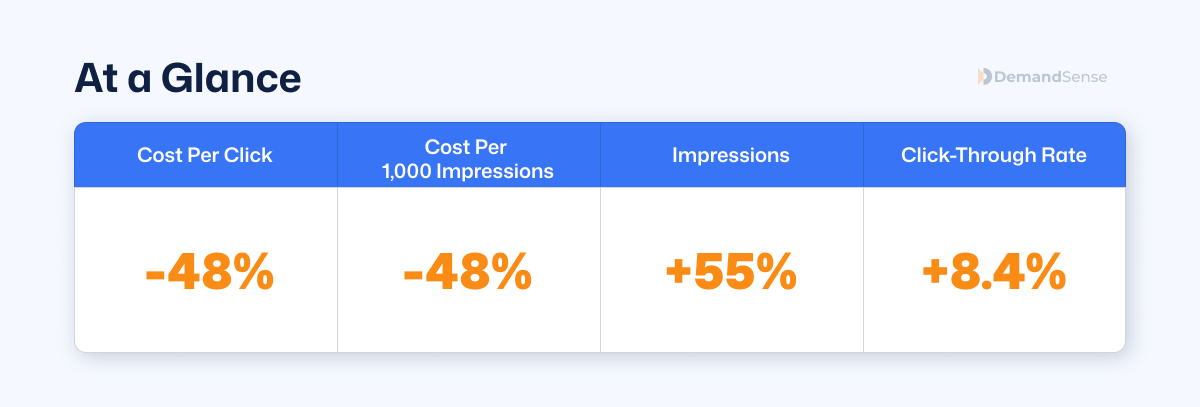
At a Glance
The Challenge
Financial services is one of the most competitive categories on LinkedIn. Large institutions run always-on campaigns with deep budgets, which means smaller players get squeezed — paying premium CPCs to compete in the same auctions, at the same hours, against advertisers who can simply outspend them.
This real estate lending company was running lead gen campaigns targeting finance and real estate professionals. The results weren't bad, but costs were climbing and the budget wasn't stretching as far as it should. The core problem wasn't the creative or the targeting. It was timing.
By running campaigns 24/7, the company was competing in every auction — including the ones that didn't matter. Overnight impressions, weekend clicks, off-hours budget burn. None of it translated into qualified engagement from the professionals they actually needed to reach.
The question was simple: what happens if you only show up when your audience is actually there?
The Approach
The team ran a clean A/B test using DemandSense's ad scheduling capabilities to isolate timing as a variable. Everything else stayed constant — same creative, same audience, same budget.
Test structure:
- Single lead generation campaign targeting real estate and finance professionals
- Two variants: always-on delivery (control) vs. strategic scheduling (test)
- Same budget, same creative, same audience targeting
- Maximum delivery bidding to establish a clean performance baseline
- 2-week test period
Scheduling parameters for the test variant:
- Weekdays only: Monday through Thursday — the window when financial professionals research, evaluate, and make decisions
- Business hours focus: 9am to 3pm, when engagement with professional content peaks
- Off-hours excluded: no budget spent on evenings, weekends, or early mornings
The hypothesis: financial professionals operate on structured schedules. Lending decisions, vendor evaluations, and content consumption happen during working hours. Advertising outside those windows isn't just inefficient — it's competing in the wrong room.
The Results
Costs Dropped Nearly in Half
Cost per click fell 48% without touching the bid strategy or reducing budget. The scheduled campaign simply stopped burning money in low-intent windows, which changed the economics immediately.
CPM dropped in parallel. By concentrating delivery during business hours, the campaign avoided the most competitive auction periods where major financial institutions dominate. Less competition at the right times turned out to be more effective than maximum exposure at all times.
Reach Expanded While Spending the Same
Impressions increased nearly 55% despite running fewer total hours. Budget that was previously wasted on off-hours delivery went further during the windows that actually mattered.
CTR improved 8.4%, meaning the same ads, shown at better times, connected more effectively with the audience.
The compounding effect matters here: lower CPM means more impressions per dollar. More relevant impressions means higher CTR. Higher CTR improves LinkedIn's quality signals, which further reduces cost over time. One timing decision cascaded across every metric.
What This Means for Financial Services Advertisers
For companies competing against large financial institutions on LinkedIn, always-on delivery is a losing strategy. You can't out-budget them. But you can out-time them — running strategically during windows they don't dominate, when your audience is most receptive.
In financial services, that means weekday business hours. Lending decisions and vendor research happen Monday through Thursday, during the workday. That's where the budget belongs.
Why It Worked
Financial professionals have structured working rhythms. Unlike consumer audiences who browse at all hours, B2B finance audiences are predictable — they engage with professional content during professional hours. Scheduling aligned the campaign with those rhythms instead of fighting them.
The result wasn't just better timing — it was a fundamentally different competitive position. By avoiding peak hours when institutional advertisers flood the auction, the campaign secured better placement at lower cost during the windows that mattered most.
Key Takeaways
Timing is a competitive advantage, not just a scheduling preference. In high-competition categories like financial services, when you advertise changes what you pay and who you reach.
Always-on delivery optimizes for LinkedIn's revenue, not yours. Strategic scheduling puts you in control of where spend actually lands.
The same budget can do dramatically more. A 48% CPC reduction and 55% impression increase didn't come from spending more — they came from spending smarter.
Want to Test This Yourself?
These results came from a controlled test using DemandSense's ad scheduling capabilities. If you're running LinkedIn campaigns and wondering whether strategic timing could improve your performance, the only way to know is to test it.
Watch a quick demo to see how DemandSense's LinkedIn ad controls work, or learn more about our scheduling features.

![How to Use LinkedIn Sales Navigator Search Filters Like a Pro [2026 Guide]](https://cdn.prod.website-files.com/67160f781eeef22eaf34d58e/69ce69e4309170b938673cf6_LinkedIn%20Sales%20Navigator%20-%20Thumbnail.png)